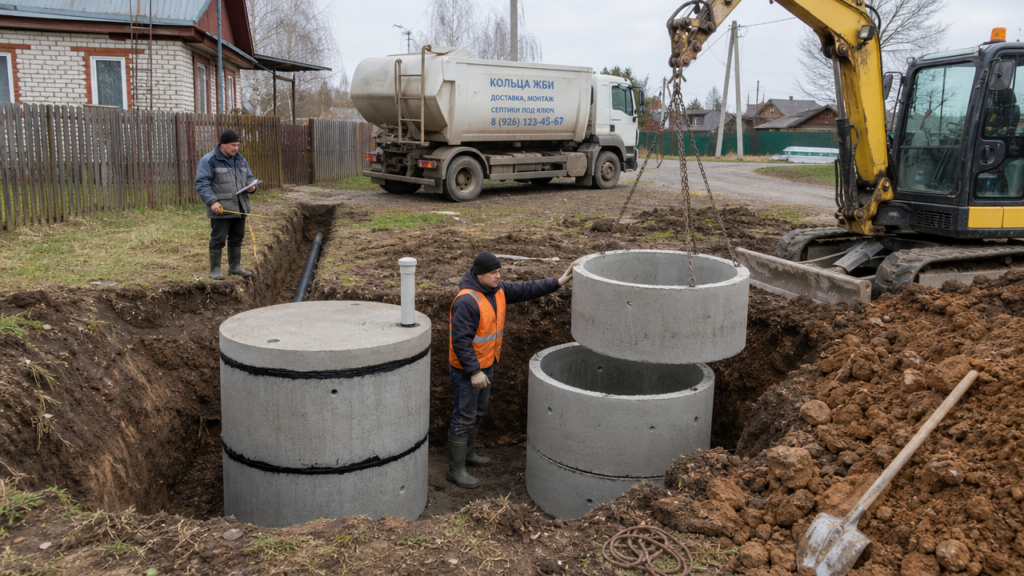
Digging septic tanks from concrete rings in Mozhaysk is a 1–2 day turnkey job when the pit dimensions, base, and pipe depths are planned correctly. A local contractor installs a two-chamber system with three rings per chamber, no electricity, and 90–95% water purification. Another local provider lists excavation and installation from 17,000 rubles, while a separate source reports a service life of 50+ years with maintenance every 1–2 years. The key variable is not the ring count alone, but how the excavation is prepared for Mozhaysk soil, frost, and groundwater.
Site Assessment and Tank Volume
A concrete ring septic tank in Mozhaysk must be sized from daily water use, not from the number of bedrooms. One source uses a baseline of approximately 200 liters per person per day, multiplied by 3 for working volume. A four-person household therefore needs about 2,400 liters, or 2.4 cubic meters, of total chamber capacity. This figure drives the ring diameter and pit depth, and it is the first number a contractor should verify before ordering delivery.
Local site factors also change the excavation plan. High groundwater in parts of Mozhaysk district can require a sealed base and external waterproofing. Sandy or clay soil affects whether the pit walls need shoring. A contractor that analyzes these factors before delivery reduces the risk of ring movement after backfill.
Pit Dimensions and Excavation Depth
The pit for concrete rings must be wider than the ring outer diameter. One source specifies a wider hole to allow external waterproofing and sealed joints around each ring. Without this working gap, the installer cannot apply joint sealant or bitumen coating properly, and backfill may not compact evenly against the ring wall.
Pipe depth is another fixed requirement. One local installation provider states that the incoming wastewater pipe must be laid at a depth greater than 120 cm to prevent freezing. The ventilation pipe must rise more than 60 cm above ground to remove gas from the chamber. These two depths determine the upper section of the excavation, because the inlet pipe elevation sets the ring lid position relative to the house plumbing.
For a standard two-chamber system of three rings per chamber, the pit must also include a concrete base below the first ring. The base supports the ring stack. Site preparation, ring laying, joint sealing, and pipe connection form the core installation sequence, with joint sealing helping protect against groundwater and moisture-related damage.
Installation Sequence
The excavation and installation process in Mozhaysk follows a fixed order. Mark the pit outline, dig the excavation, pour or place a concrete base, lower the rings with a crane, align the tongue-and-groove or special groove joints, seal the seams, connect the inlet and outlet pipes, install the lid and ventilation riser, and then backfill in layers. Local suppliers offer reinforced concrete rings in several sizes that meet GOST standards for drinking water safety and use special grooves for secure connections.
Frost resistance matters in Mozhaysk winters. Rings rated at M250 are frost-resistant and have been laboratory tested, according to one local supplier. The same source notes that the rings contain no harmful additives and are used for wells, hygienic dacha toilets, and multi-chamber septic systems. Difficult deliveries in the district are handled with cranes, which is essential when a site has limited access or a narrow gate.
Chamber Types and Local Choices
A one-chamber concrete ring septic tank without a bottom is the simplest and most cost-effective option for autonomous sewage in Mozhaysk district. One source describes it as suitable where soil filtration is acceptable, but it requires a mandatory ventilation pipe to remove gas, external waterproofing, and sealed joints. This type is not a fully sealed system and should not be used where groundwater protection is strict.
Two-chamber sealed systems provide the 90–95% purification figure cited by a local installer, with no electricity needed. The chambers support staged treatment through mechanical separation and further settling or biofiltration. Local installation providers list additional types: sealed, multi-stage, and ready-made tanks, plus brick, metal, and plastic alternatives. Other local sources add filtration fields and biological stations as higher-treatment options, while classic concrete tanks remain a common replacement for old pit toilets that cause odors, groundwater pollution, and possible fines.
Cost, Maintenance, and Contractor Selection
Budget numbers in Mozhaysk start low but rise with ring count, crane access, and sealing work. A local installation provider advertises excavation and installation from 17,000 rubles with fixed pricing and delivery. A two-chamber system with six total rings, concrete base, pipe connections, and lid typically costs more than the entry price because of the extra material and crane time.
Maintenance is annual to biennial. One source states that modern concrete septic tanks require cleaning every 1–2 years, while another specifies annual cleaning for its two-chamber system. That supports a practical rule: budget one pump-out call per year in Mozhaysk, and inspect the ventilation riser after heavy snow or ice.
For a four-person household, the practical specification is a two-chamber sealed concrete ring system with three rings per chamber, a pit wide enough for waterproofing and joint sealing, an inlet pipe deeper than 120 cm, a ventilation riser more than 60 cm above ground, and a concrete base under the first ring. Choose a contractor in Mozhaysk that delivers with a crane, uses certified M250 rings, and seals every joint rather than just lowering rings into the hole. The price below 17,000 rubles for a full excavation and installation should be treated as a partial job unless the contractor confirms the base, sealing, pipe connection, and backfill in writing.